From Golden Hour to the Milky Way
Ancient limestone spires, blood-orange sunsets, and a galaxy of stars — one of Australia’s most otherworldly family experiences.
We visited the Pinnacles twice — and I would do it again without hesitation. The first time was in mid-August, arriving just before sunset. The kids went completely silent the moment we drove into the desert. That almost never happens. Thousands of limestone spires rising from golden sand in every direction, the light turning everything amber, and not a building in sight. It felt like we had accidentally driven onto the surface of Mars.
The second visit was at night, around 8pm. The temperature had dropped to a proper chill — mid-August in Western Australia is genuinely cold after dark — but nobody complained. The Milky Way was directly overhead, stretching from one horizon to the other above the spires. That is the reason I am writing this post.
The Pinnacles Desert, located within Nambung National Park approximately 245 kilometres north of Perth, is one of the most visually arresting natural landscapes in Australia.[1] It is not a theme park, it is not curated, and it does not need to be. Thousands of ancient limestone pillars — some reaching up to 5 metres in height — erupt from a vast expanse of yellow quartz sand, creating a scene that is simultaneously prehistoric and cinematic.
For families travelling with children, the Pinnacles offers something genuinely rare: a place that is accessible, affordable, and genuinely awe-inspiring for every age group. You can drive through the desert loop in a standard passenger car, walk among the formations at your own pace, and — if you time it right — watch the Milky Way arc over the spires in one of the darkest skies on the Australian coast.
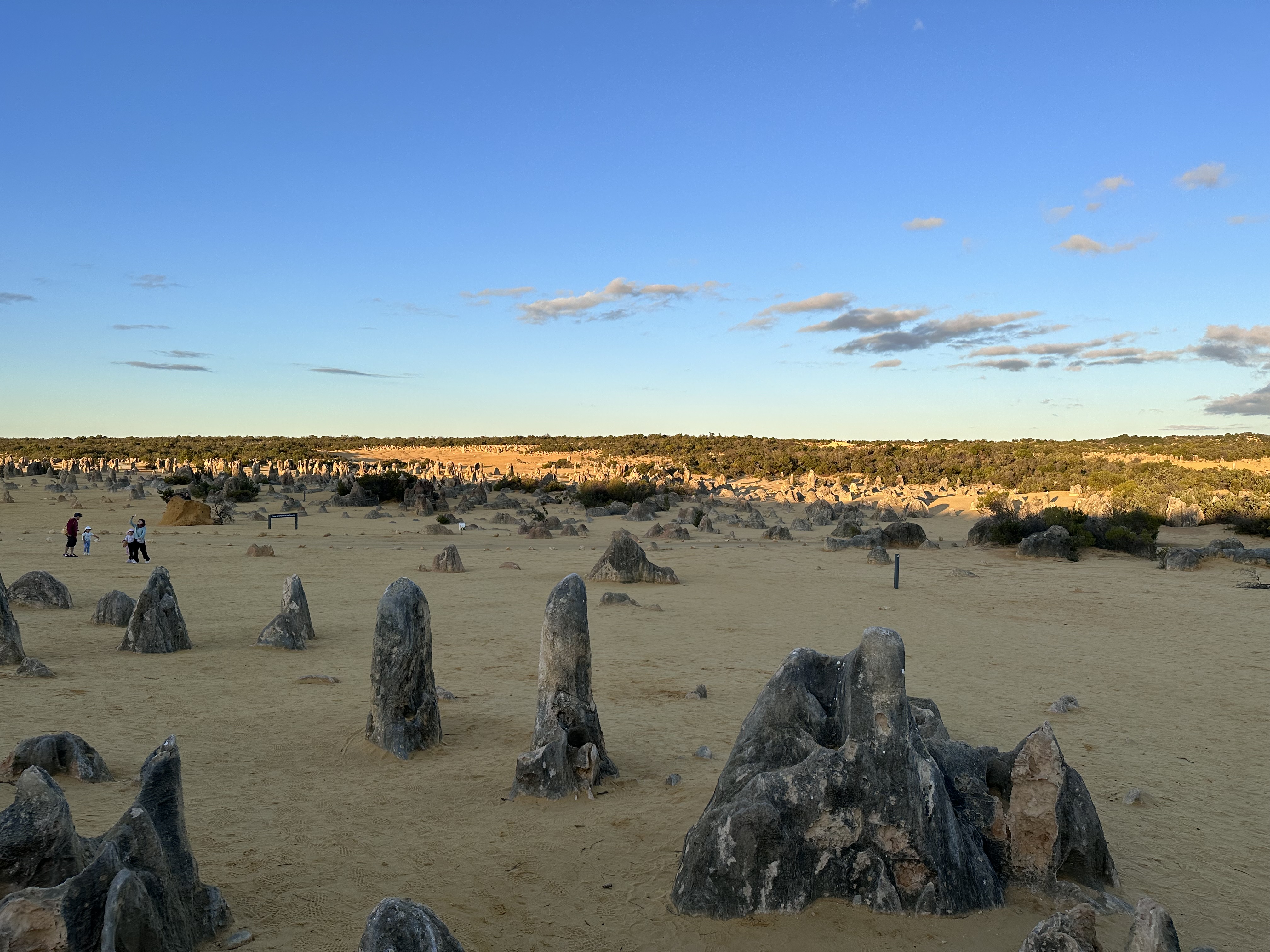
Golden hour at the Pinnacles — the low sun turns the sand amber and the limestone spires take on a deep, sculptural quality. The scale only becomes apparent when you spot other visitors in the distance.
How Did These Spires Form? (The Science Your Kids Will Actually Find Cool)
The Pinnacles are the result of a geological process that began roughly two million years ago, when the area was submerged beneath a shallow sea.[2] Marine organisms — shellfish, corals, and other calcium-rich life — accumulated on the seafloor. As sea levels fell, these deposits were exposed and gradually transformed into the Tamala Limestone formation, a near-continuous belt of coastal limestone stretching over 1,000 kilometres along Western Australia’s coast.[3]
The spires themselves were shaped approximately 100,000 years ago during an exceptionally wet climatic period, according to a landmark 2024 study published in the journal Science Advances.[4] Acidic rainwater dissolved the surrounding limestone, leaving behind the harder, more resistant cores — the pillars we see today. Think of it as the limestone equivalent of Swiss cheese: the holes got so large that only the solid pieces remained standing.
The Yued people, the Traditional Custodians of this land, know the site as “Kwong-kan” (sandy place). In their oral tradition, the rocks represent the fingers and hands of warriors swallowed by the desert for disobeying their elders — a story that carries a weight and poetry no geology textbook can match.[4]
Before you arrive, tell your kids: “These rocks are made from the shells of sea creatures that lived here when dinosaurs were still around. The sea is now 6 km away.” Watch their faces. The on-site signage at the Pinnacles View lookout covers this well — it is worth reading before you set off on the loop.
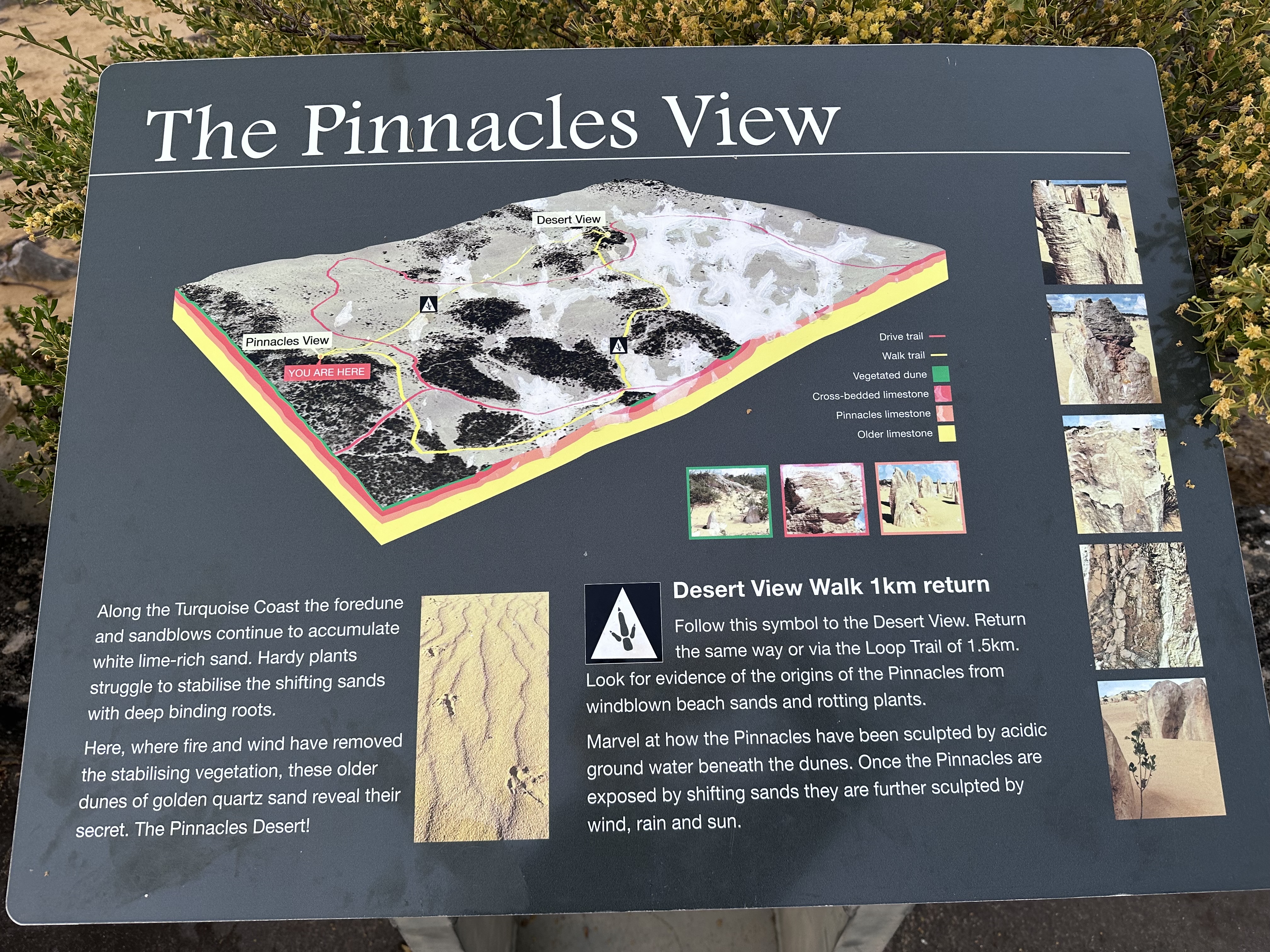
The Pinnacles View interpretive board — a 3D geological cross-section showing the drive trail, walk trail, and the different limestone layers beneath the sand. Worth reading before you set off on the loop.
Getting There from Perth
The Pinnacles are located near the small fishing town of Cervantes, approximately a 2.5-hour drive north of Perth via the Indian Ocean Drive (Route 60). The road is fully sealed and suitable for standard passenger vehicles — no 4WD required.[5] The route along the Indian Ocean Drive is itself scenic, hugging the coast past Lancelin and the white sand dunes, making the drive a worthwhile part of the experience.
| Detail | Information |
|---|---|
| Distance from Perth | ~245 km (approx. 2.5 hours drive) |
| Route | Indian Ocean Drive (Route 60) north via Lancelin |
| Road Condition | Fully sealed; standard 2WD passenger car suitable |
| Park Entry Fee | AUD $15 per vehicle (up to 12 passengers)[6] |
| Discovery Centre Hours | Daily 9:30 am – 4:30 pm (closed Christmas Day)[7] |
| Desert Loop Drive | 4 km one-way unsealed loop; open 24 hours, all year |
| Nearest Town | Cervantes (~15 min drive from the park entrance) |
| Pets | Not permitted within the national park |
The Discovery Centre closes at 4:30 pm, but the desert loop itself is open 24 hours. The best light for photography and the most comfortable temperatures for children are after 4:00 pm. Plan to arrive in the late afternoon, explore the loop at golden hour, and stay for sunset. If you intend to stargaze, you will be well past closing time for the centre — this is completely fine and expected.
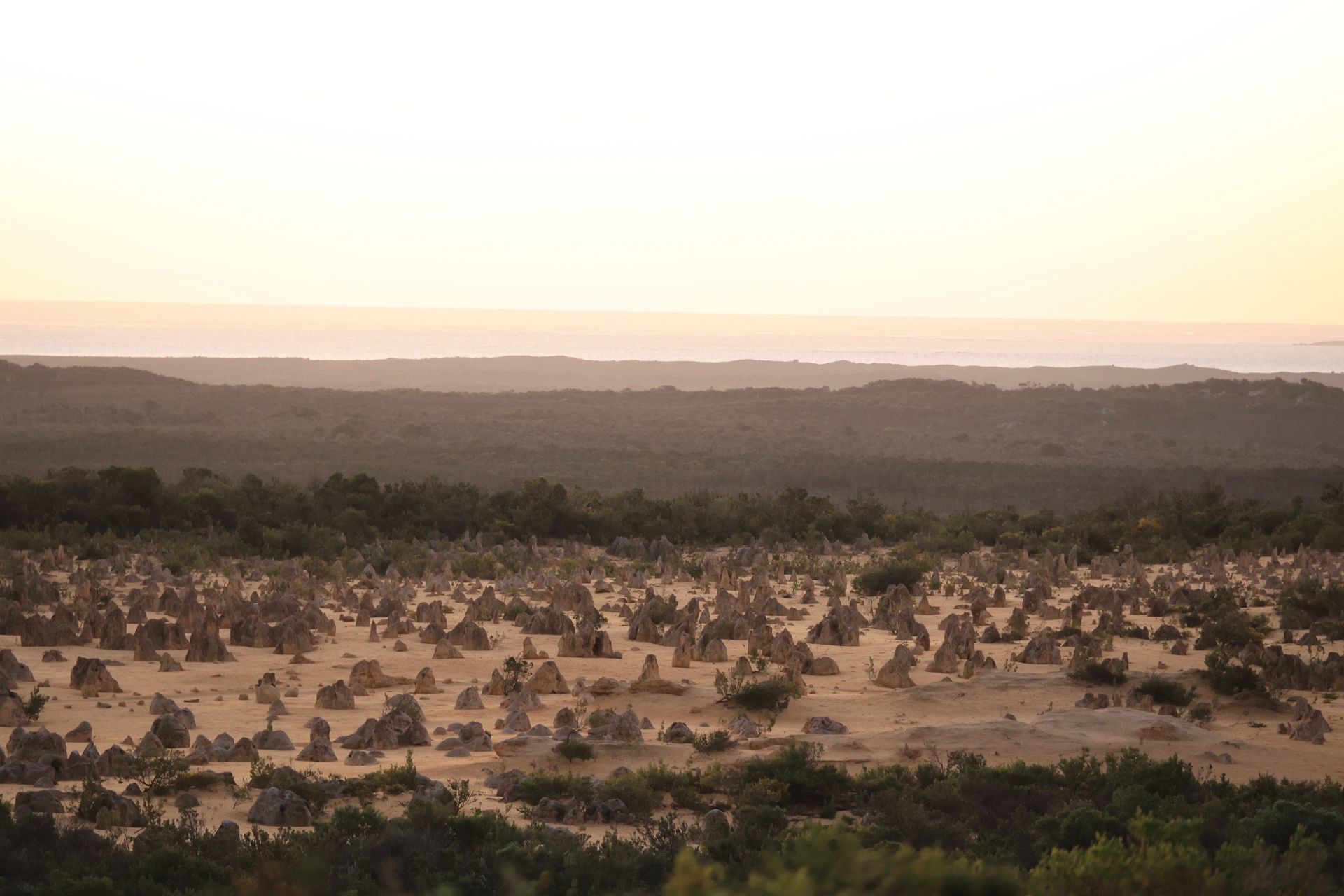
The scale of the Pinnacles Desert is best appreciated from the elevated lookout. Thousands of spires stretch to the horizon, with the Indian Ocean visible just 6 km away — a reminder of the marine origins of these ancient formations.
What to Do: A Family Itinerary
The Pinnacles does not require a rigid schedule, but having a loose framework will ensure you make the most of the different experiences on offer — particularly if you plan to stay for the night sky.
The Desert Loop Drive (4 km)
The unsealed 4 km one-way loop through the desert is the centrepiece of any visit. It is suitable for all standard passenger vehicles and takes approximately 30–45 minutes at a leisurely pace, with multiple pull-over bays allowing you to stop, get out, and walk among the formations. Children can move freely between the spires — the terrain is sandy and flat, making it manageable for young legs.
The Emu Bush Walk Trail (1.6 km)
Starting from the Discovery Centre, this easy 1.6 km walk winds through the desert landscape and provides a more intimate perspective of the formations than the drive alone. Allow approximately 40 minutes. The trail is well-marked and suitable for children aged 4 and above.
The Desert View Walk (1 km return)
A shorter 1 km return walk leading to the Desert View lookout — the best elevated vantage point in the park. The lookout is wheelchair-accessible and provides a sweeping panorama of the entire desert, with the Indian Ocean visible on the horizon.
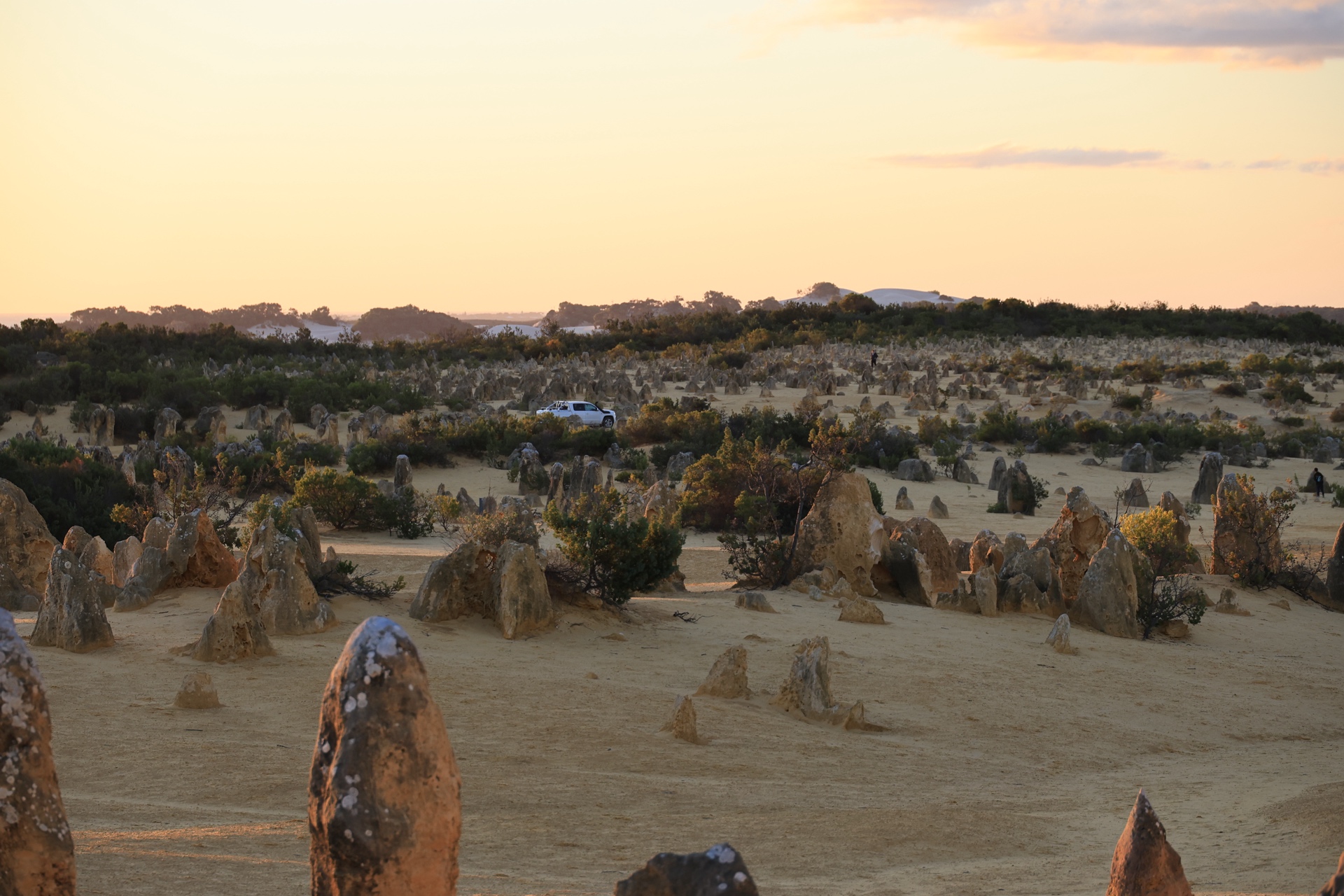
The desert loop drive at sunset — you can pull over at any of the designated bays to step out and photograph the formations. A standard passenger car handles the unsealed loop without any difficulty.
Timing: The Golden Hour and Sunset Window
The transformation that occurs in the final 90 minutes before sunset is the single most compelling reason to time your visit carefully. As the sun drops toward the horizon, the quartz sand shifts from pale yellow to deep amber, the limestone spires cast long dramatic shadows, and the entire desert takes on a warm, cinematic quality.
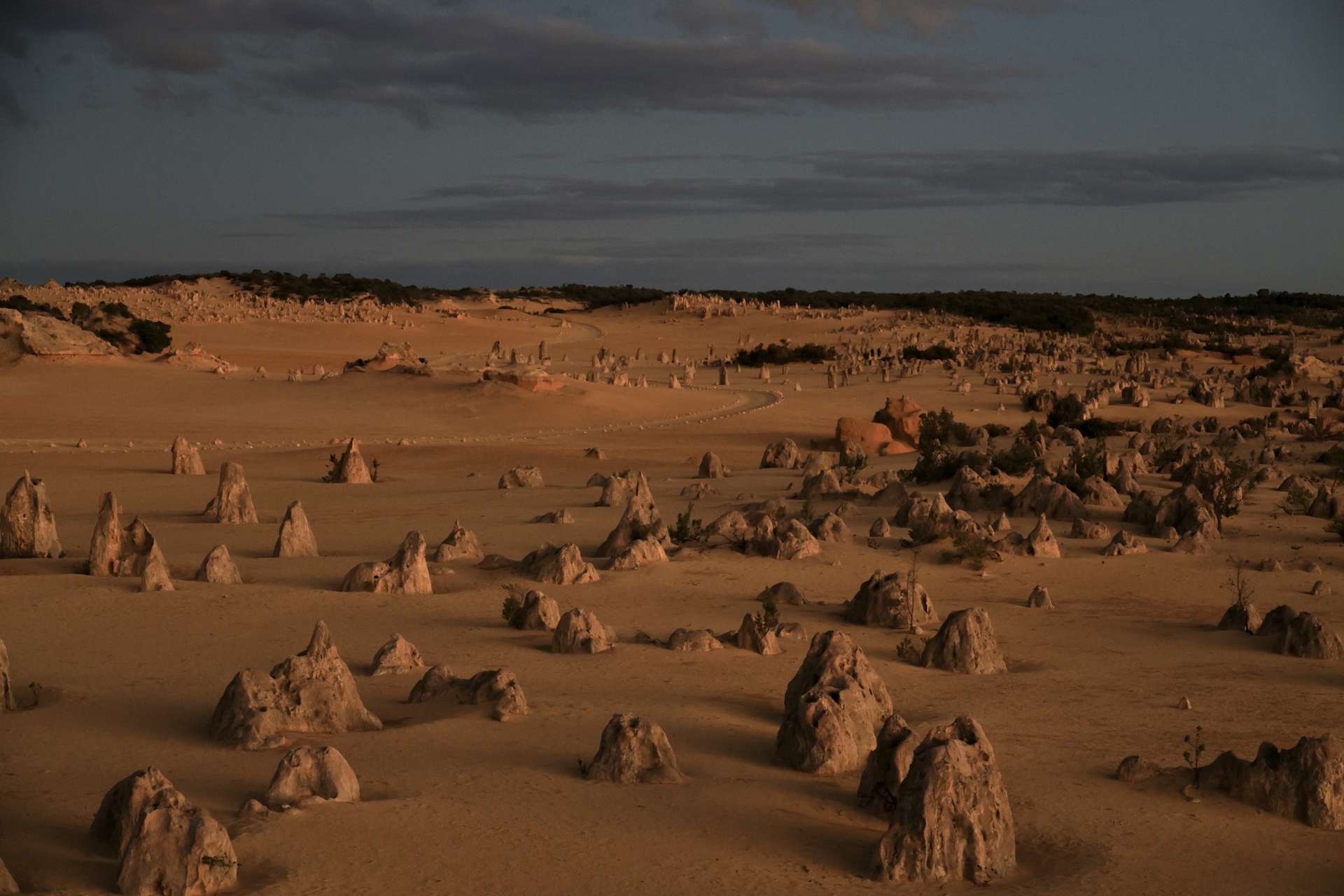
Deep into golden hour — the sand turns a rich terracotta and the limestone pillars glow. This light lasts approximately 20–30 minutes before the sun drops below the tree line.
Stargazing at the Pinnacles: A Genuinely Rare Experience
This is the section most family travel guides skip, and it is a significant omission. The Pinnacles Desert sits on one of the darkest stretches of coastline in Australia, far enough from Perth’s light pollution to offer a night sky that most city-dwelling children will never have seen before.[8] The Milky Way is visible to the naked eye. On a clear winter night, it is not subtle — it is a luminous band stretching from horizon to horizon, directly above the spires.
We arrived for our second visit at around 8pm in mid-August. The temperature had dropped sharply — bring a proper jacket, not just a light layer — but the sky was completely clear. Standing in the desert surrounded by ancient limestone pillars, with the Milky Way overhead and the faint glow of the Indian Ocean on the horizon, is one of those rare moments that recalibrates your sense of scale. For children who have grown up in cities, it is genuinely transformative.
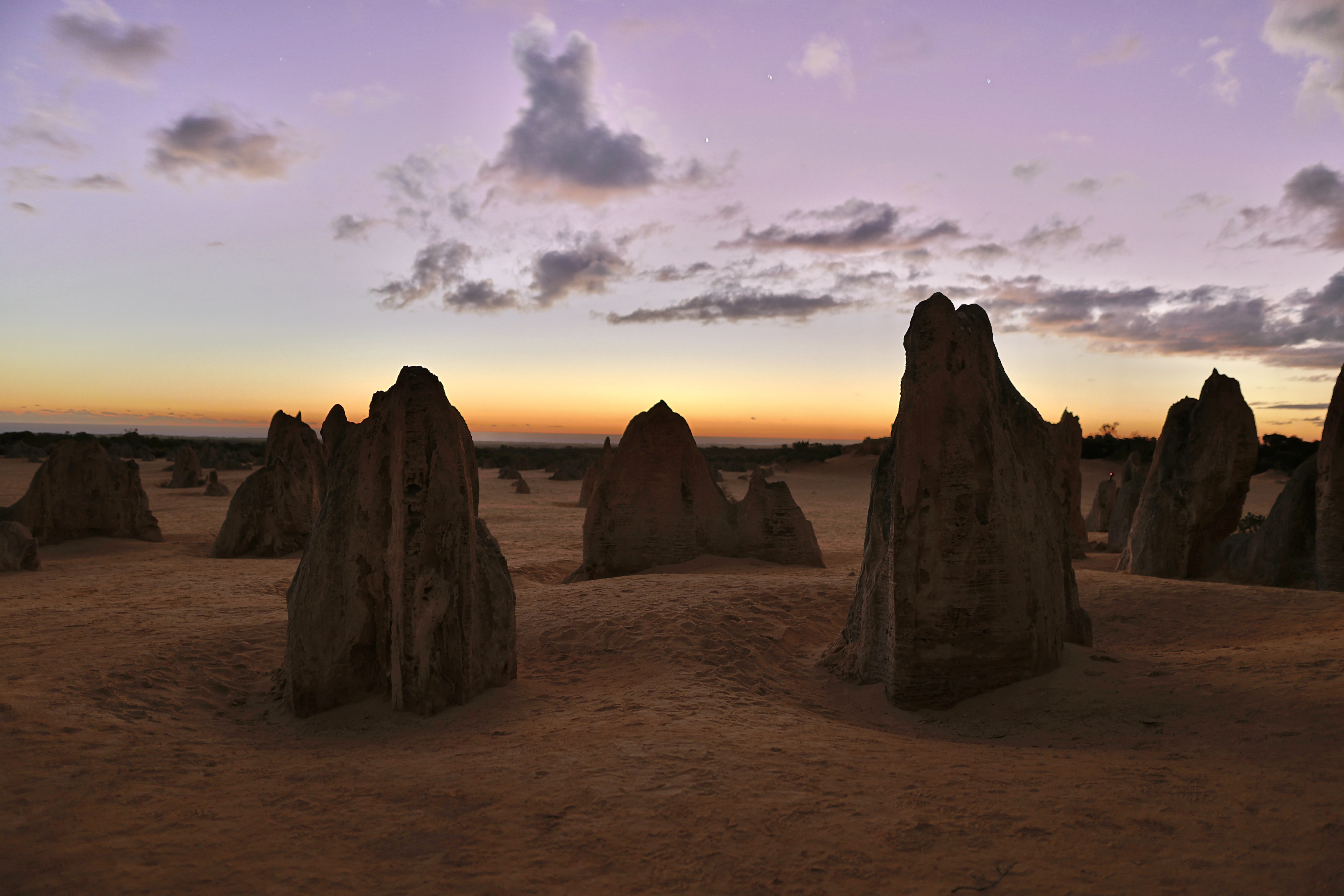
The brief window between sunset and full dark — the sky shifts from orange to deep violet, and the spires become pure silhouette. This is the same image used as the hero, shown here at full resolution.
The Milky Way core is most visible from April to September (Australian autumn and winter), peaking around June and July. Aim for a new moon or crescent moon phase for maximum darkness. Bring a tripod and set your camera to ISO 3200–6400, f/2.8 or wider, with a 20–25 second exposure. The spires make exceptional foreground subjects.
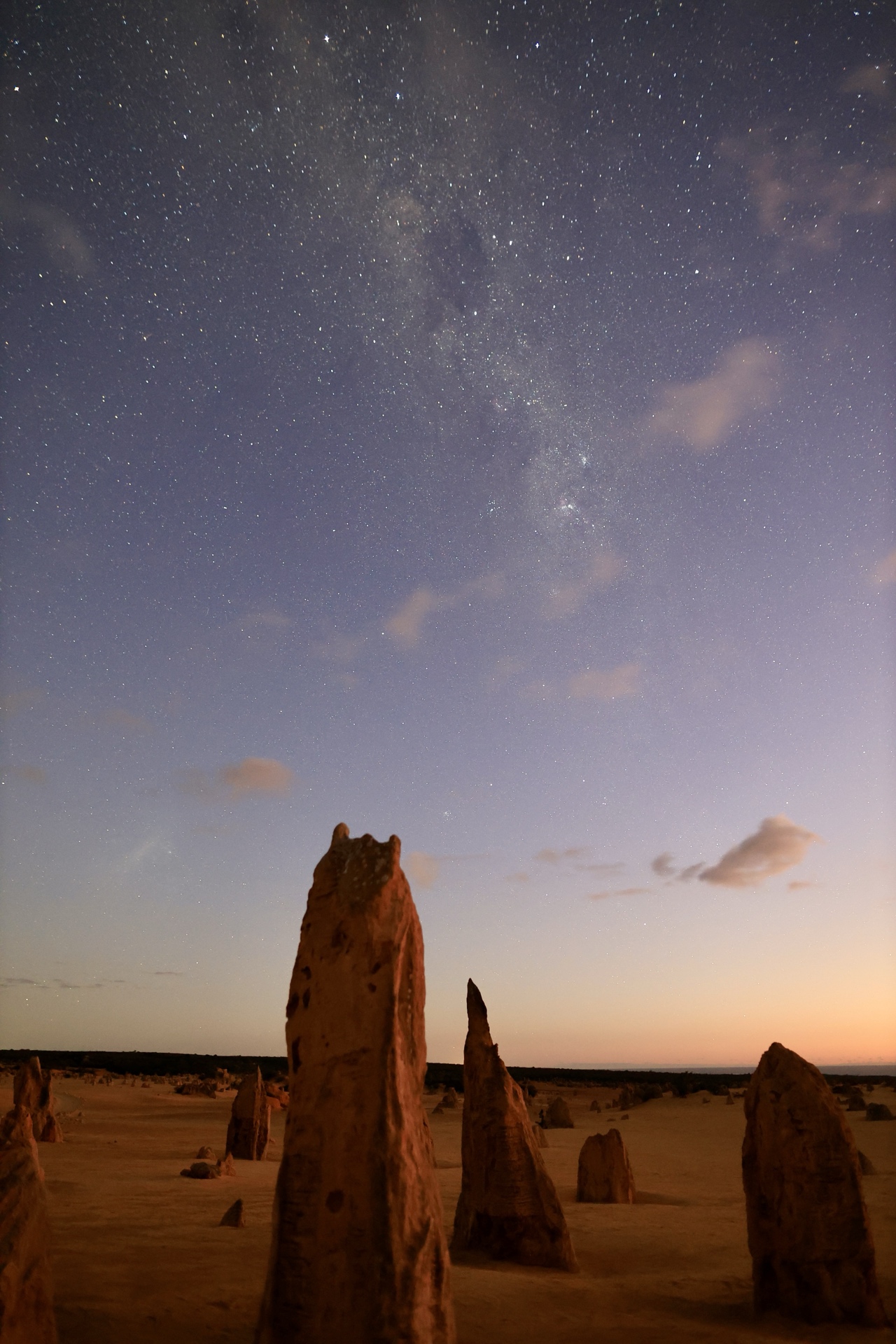
The transition from sunset to night — the last traces of orange on the horizon, the first stars appearing, and the Milky Way beginning to emerge above the spires. This is the window between 30 and 60 minutes after sunset.
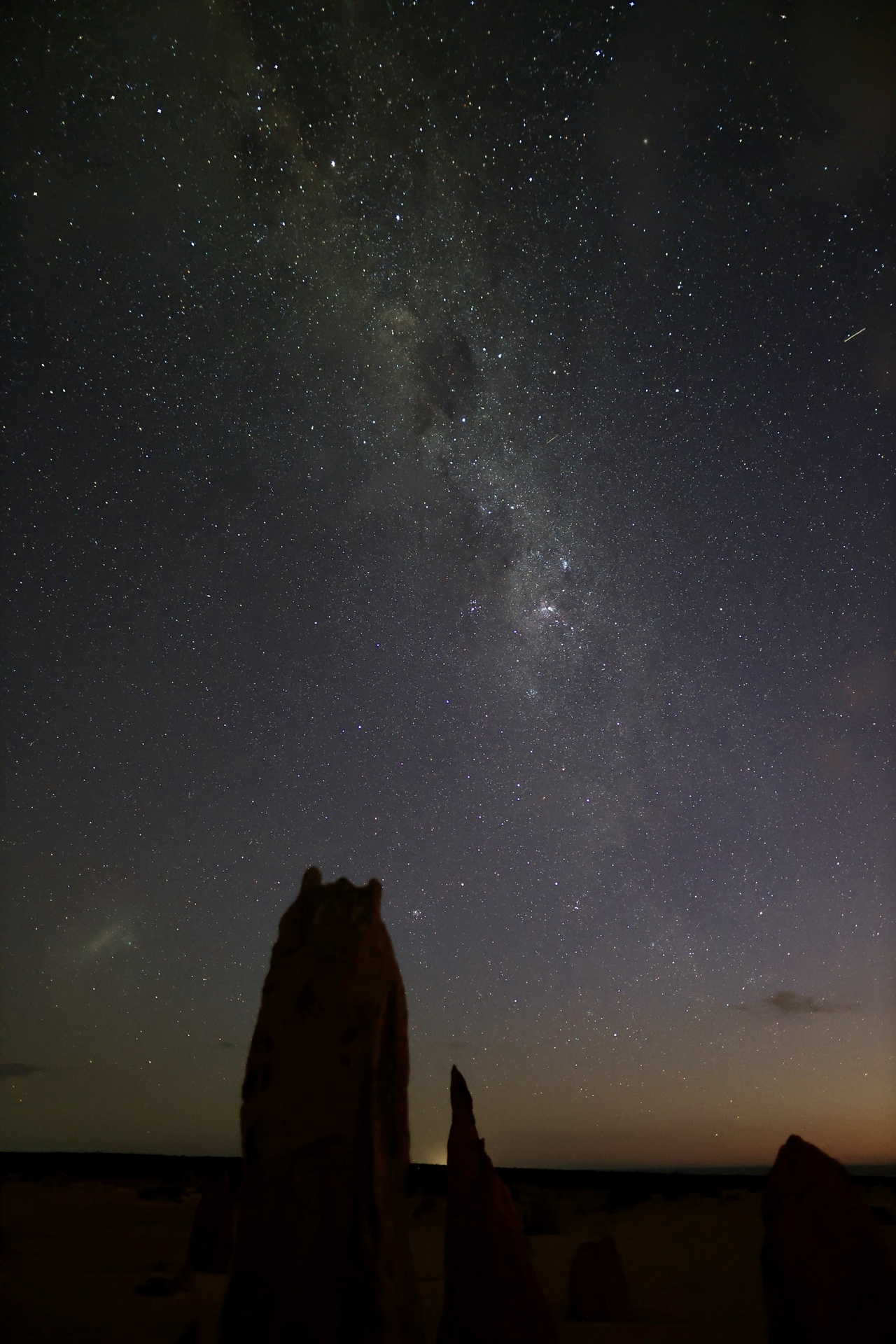
The Milky Way fully visible over the desert, with the Indian Ocean glow on the horizon.
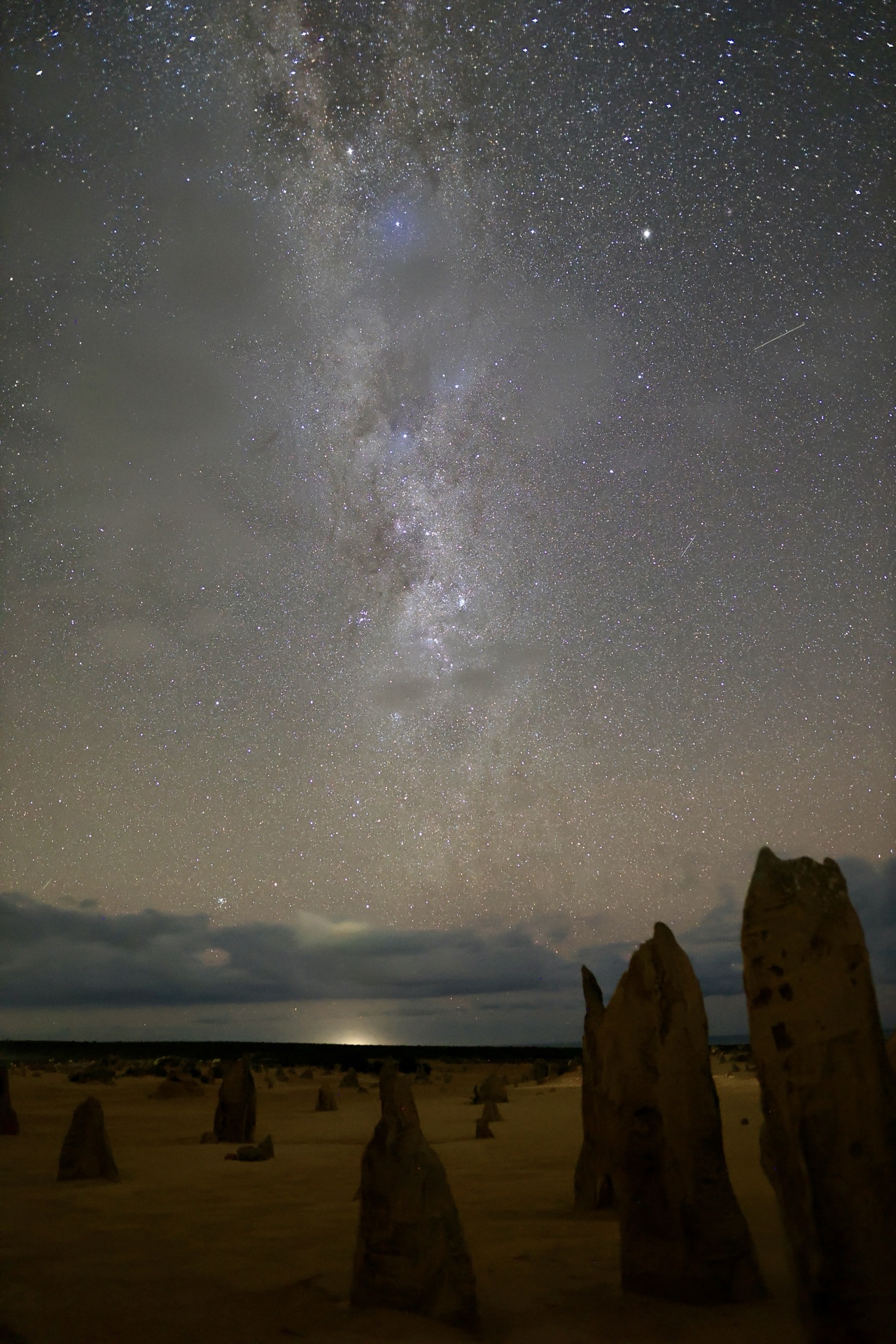
The full arc of the Milky Way above the Pinnacles — visible to the naked eye on a clear, moonless night.
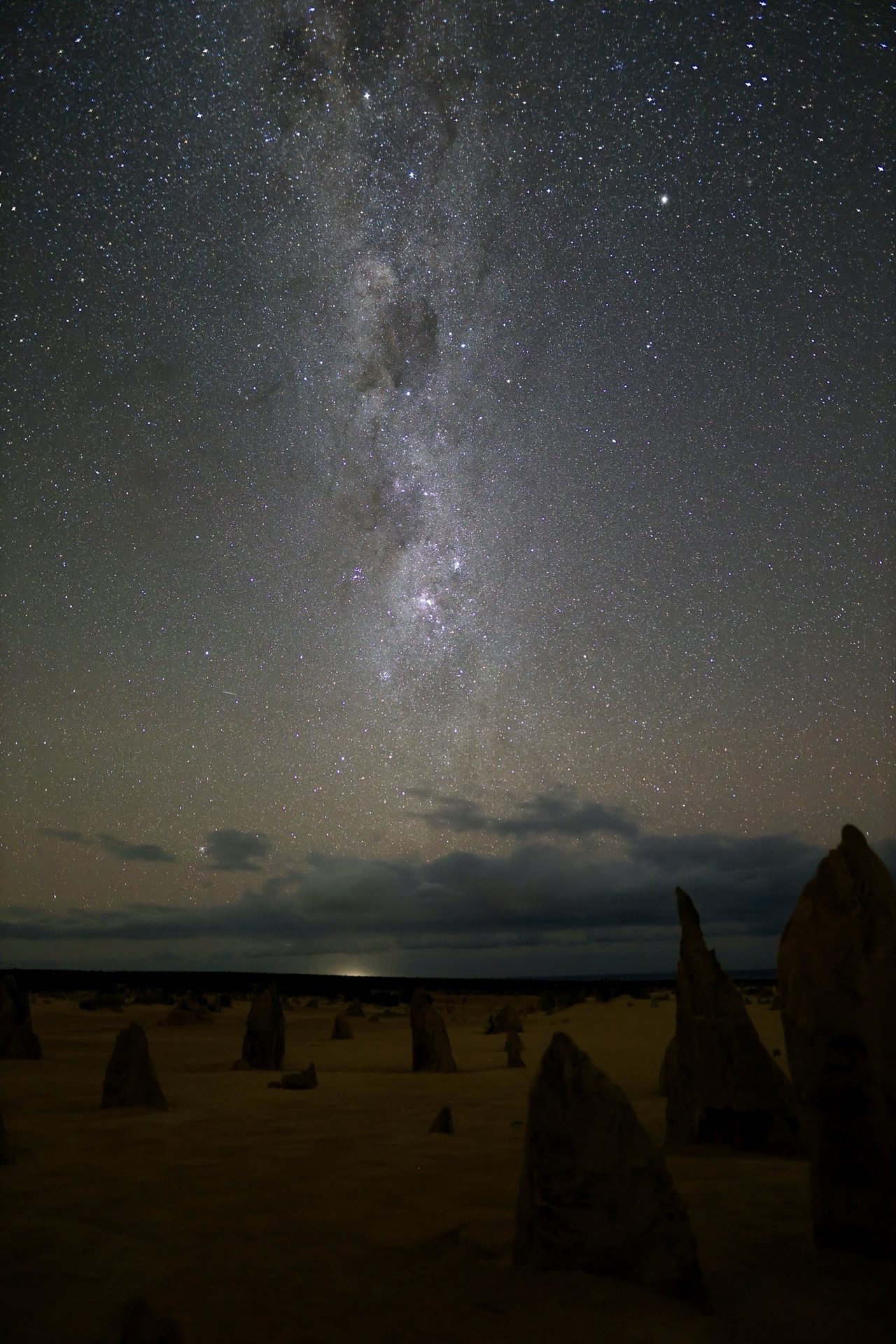
The Milky Way at its most dramatic — the galactic core fully resolved above the Pinnacles. No filter, no composite. This is what the sky looks like here on a clear winter night.
- The desert loop is unsealed. Drive slowly at night — kangaroos and emus are active after dark and will not move for your headlights.
- Bring a red-light torch (not white light) to preserve your night vision and avoid disrupting other photographers’ long exposures.
- Temperatures drop significantly after sunset, even in summer. In mid-August, expect genuine cold — pack a proper jacket for every member of the family.
- There is no mobile reception inside the park. Download offline maps before you leave Cervantes.
Wildlife: What to Look For
The Pinnacles Desert is not just rock and sand. The surrounding scrubland supports a range of native wildlife that is most active at dawn and dusk. Emus are commonly spotted wandering between the spires — they are entirely unbothered by visitors and will walk within metres of you. Western grey kangaroos are frequently seen grazing at the edges of the desert, particularly in the early morning. The White-tailed Black Cockatoo and the Splendid Fairy-wren are among the bird species recorded in the area.[9]
For children, spotting an emu among the limestone pillars is a highlight that no amount of museum exhibits can replicate. Keep the noise down as you approach dusk, and you are likely to be rewarded.
Arrive at the park entrance at least 30 minutes before sunset. Emus and kangaroos are most active in the hour before dark. The Discovery Centre staff can advise on recent sightings if you arrive during opening hours.
What Else Is Nearby: Making It a Full Day
The Pinnacles works well as a day trip from Perth, with a sunset visit followed by a separate evening return trip if you want to experience both the golden hour and the night sky. The town of Cervantes is a 15-minute drive from the park entrance and has dining options and fuel.
Lake Thetis, Cervantes (15 min from the park)
One of the most underrated stops on the Turquoise Coast. Lake Thetis contains living thrombolites — dome-shaped microbial structures that are among the oldest living organisms on Earth, estimated to be over 3,000 years old and closely related to the stromatolites that dominated Earth’s oceans more than 2 billion years ago.[10] There is a short boardwalk around the lake suitable for all ages. Pair this with the Pinnacles and you have a full day of natural history.
Lancelin Sand Dunes (1 hr south of Cervantes)
If your children need to burn energy, the white sand dunes near Lancelin offer sandboarding — a straightforward, low-cost activity that children of most ages enjoy. Several tour operators run combined Pinnacles and sandboarding day trips from Perth if you prefer a guided experience.
The Lobster Shack, Cervantes
Cervantes is one of Western Australia’s premier rock lobster fishing towns. The Lobster Shack offers waterfront dining and a factory tour that provides an insight into the region’s commercial fishing industry. Open for lunch daily 11:00 am – 3:00 pm. Arrive after 2:00 pm for a better chance of a waterfront table.
Practical Information for Families
What to Bring
The Pinnacles Desert is an exposed environment. There is minimal shade, no food or water available inside the park, and temperatures vary significantly between day and night — particularly in the cooler months. Preparation is not optional.
- Sunscreen SPF 50+ (reapply every 2 hours)
- Snacks and lunch (no food inside the park)
- Wide-brim hats for all family members
- Torch or headlamp (red light preferred for night)
- Sunglasses with UV protection
- Camera with tripod (for stargazing)
- Minimum 2 litres of water per person
- Offline maps downloaded (no mobile reception)
- Closed-toe shoes (sand can be very hot in summer)
- Cash or card for park entry fee (AUD $15)
- Light long-sleeve layers (for evening chill)
- First aid kit
- Insect repellent
- Spare warm jacket per person (nights are cold)
Summer temperatures at the Pinnacles can exceed 40°C. Visiting between 10:00 am and 3:00 pm in December through February is strongly discouraged for families with young children. The sand radiates heat and there is virtually no shade. If you must visit in summer, arrive at sunrise or after 4:30 pm. Mid-August, by contrast, is excellent — mild days and cool, clear nights ideal for stargazing.
Accessibility
The Desert View lookout is wheelchair-accessible. The desert loop drive is suitable for standard vehicles. The walking trails involve soft sand which may be challenging for prams and wheelchairs. The Discovery Centre has accessible facilities including toilets.
Best Time of Year to Visit
| Season | Conditions | Recommendation |
|---|---|---|
| Spring (Aug–Oct) | Wildflowers in bloom, mild temperatures, good light | Highly recommended for families |
| Autumn (Mar–May) | Cooling temperatures, Milky Way season begins | Excellent for stargazing |
| Winter (Jun–Aug) | Cold nights, peak Milky Way visibility, few crowds | Best for Milky Way photography |
| Summer (Dec–Feb) | Extreme heat, harsh midday light | Avoid midday; sunrise/sunset only |
References
- Parks and Wildlife Service WA. “Pinnacles Desert Lookout and Drive.” Explore Parks WA. exploreparks.dbca.wa.gov.au
- National Rock Garden. “Formation of the Pinnacles, Western Australia.” nationalrockgarden.com.au
- Barham, M. & Lipar, M. (2024). “Western Australia’s Pinnacles formed 100,000 years ago.” ABC News Science. abc.net.au
- Lipar, M. et al. (2024). “Dating the Pinnacles karst.” Science Advances. Via ABC News, October 2024.
- Little Wandering Wren. “The Pinnacles Desert, Nambung National Park.” littlewanderingwren.com
- Visit Pinnacles Country. “Nambung National Park.” visitpinnaclescountry.com.au
- Parks and Wildlife Service WA. “Pinnacles Desert Discovery.” Explore Parks WA. exploreparks.dbca.wa.gov.au
- Reddit r/space. “220-degree Milky Way panorama at The Pinnacles Desert, WA.” December 2021. reddit.com
- Atlas of Living Australia. Species records within 5 km of Pinnacles Desert Discovery Centre. ala.org.au
- Little Wandering Wren. “Lake Thetis, Cervantes.” littlewanderingwren.com