
SHIBUYA SKY
Tokyo’s Undisputed King of the Skyline
Standing 229 meters above the world’s busiest pedestrian crossing, Shibuya Sky has officially shifted from being a “new” attraction to the undisputed king of Tokyo’s skyline. As a hodophile, I’ve seen my fair share of observation decks, but there is something fundamentally different about this one.
It isn’t just a view; it’s an immersive, open-air experience that makes you feel like you’re floating over a sea of neon. If you’re planning your 2026 Tokyo itinerary, here is everything you need to know about conquering the summit of Shibuya Scramble Square.
1. The Ascent: More Than Just an Elevator
Your journey begins on the 14th floor, but the real magic starts in the Sky Gate. The transition from the 14th to the 45th floor happens in a high-speed elevator called the “Transition Pod.”
Forget boring mirrors—the ceiling is a digital canvas of synchronized visuals and 3D soundscapes. By the time the doors open, your brain has been successfully recalibrated for the “Sky” experience. It’s a deliberate piece of sensory storytelling that builds the anticipation before you even see the horizon.

2. Sky Stage: The Rooftop Revolution
Once you step onto the 47th floor, you’re in the Sky Stage. Unlike the Tokyo Skytree or Tokyo Tower, which keep you safely behind thick glass, Shibuya Sky is a 2,500-square-meter open-air playground.

Sky Edge:
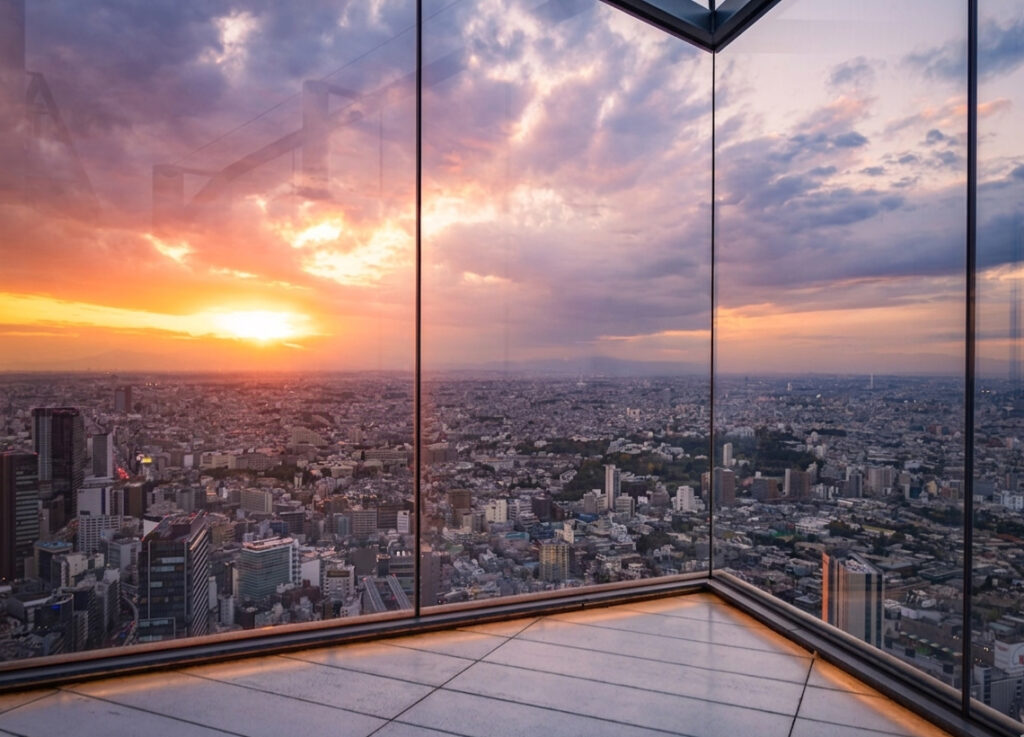
This is the viral corner. It’s a glass-walled nook where the barrier drops slightly lower, offering an unobstructed view of the Scramble Crossing directly below. Expect a queue here—everyone wants that “edge of the world” photo.

Cloud Hammocks:
Yes, there are literal netted hammocks where you can lie back and watch the clouds (or the stars) pass by. It’s surprisingly peaceful despite being in the heart of the world’s loudest city.

Geo Compass:
The highest point of the deck features a compass mapped onto the floor, showing you exactly where iconic landmarks like Mt. Fuji, Tokyo Tower, and The Imperial Palace sit on the horizon.

3. The “Golden Hour” Strategy
If there is one piece of advice I can give you for 2026, it’s this: The Sunset Slot is the Holy Grail.

In 2026, the demand for sunset tickets is higher than ever. You want to book a time slot roughly 60 to 90 minutes before the official sunset. This allows you to see the city in three distinct phases:
- Golden Hour: When the glass skyscrapers of Shinjuku start to glow like embers.
- The Blue Hour: When the streetlights and neon signs of Shibuya flicker to life.
- Nightfall: When the “Crossing Light” show begins—searchlights from the roof beam into the sky every 30 minutes after 19:00.

4. Sky Gallery: The Indoor Oasis
Don’t rush back down once you’ve seen the roof. The 46th floor houses the Sky Gallery. This indoor observation corridor is perfect if the wind gets too biting (which it does, even in spring).

It features interactive digital art like “Time River” and “Data Scape,” which use real-time Tokyo data to create evolving visual displays. It’s also where you’ll find Paradise Lounge, a sleek music bar where you can grab a coffee or a cocktail while perched on a barstool overlooking the city.

5. Essential Logistics for 2026
- Booking: Tickets release exactly two to four weeks in advance at midnight JST. Sunset slots often sell out within minutes. Use the official website or reputable partners like Klook to snag them early.
- Price: Expect to pay around 2,700 to 3,400 JPY for adults (online tickets are usually 300 JPY cheaper than walk-ins).
- The Locker Rule: They are strict. You must store all loose items—bags, hats, scarves, and even tripods—in a 100-yen-deposit locker on the 46th floor before hitting the rooftop. Only your phone and a camera with a neck strap are allowed.
- Weather: If it rains or there are high winds, the rooftop will close for safety. You’ll still have access to the indoor Sky Gallery, but the “open-air” magic will be off-limits.
Pro Tip:
After you descend, don’t just leave the building. The lower floors of Shibuya Scramble Square host some of the best depachika (basement food halls) in Tokyo. Grab some high-end seasonal fruit or a bento box to celebrate your successful “climb.”
Shibuya Sky isn’t just about looking at Tokyo; it’s about feeling the scale of it. Whether you’re a photographer chasing the perfect light or a traveler looking for a “main character” moment, this is the one spot in Tokyo that actually lives up to the hype.
#ShibuyaSky #TokyoTravel #JapanTravel #ObservationDeck #ShibuyaScrambleSquare
Book Your Tokyo Adventure


#JapanTravel #Klook #eSIMJapan #ShibuyaSky #TokyoTravel #HopOnHopOff